Blog • 8 min read
The Courage to Build Again
By Neil Garcia La-as
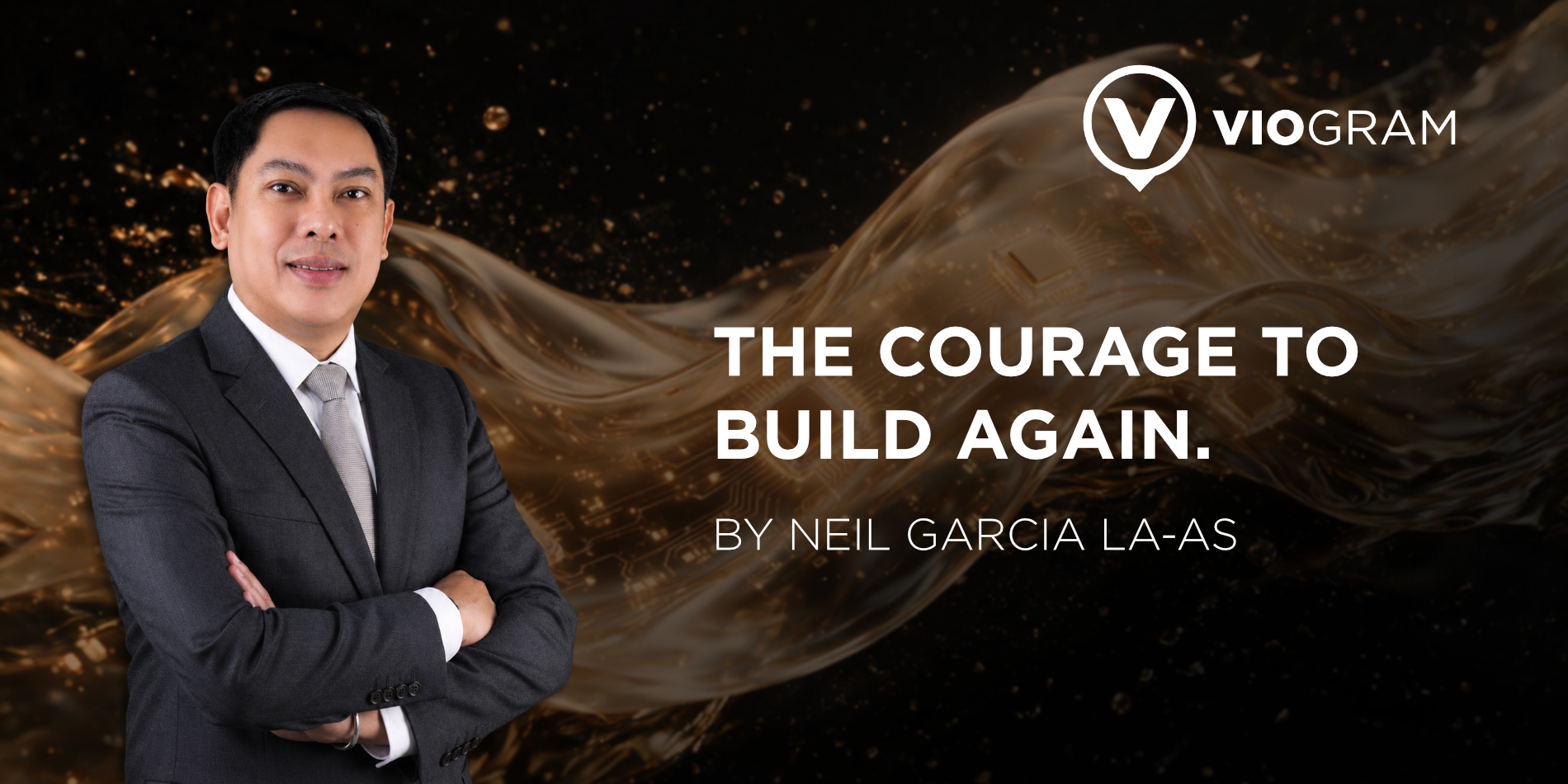
Viogram is not yet the company I envision. My story is not a comeback story — at least not yet. It is the story of deciding to start again while the outcome remains uncertain.
I am building again.
Perhaps that is the most accurate way to describe where I am today.
Not I have rebuilt. Not I have succeeded again. Not I have overcome everything.
Simply: I am building again.
My name is Neil Garcia La-as. I am an entrepreneur, and today I am building Viogram. Viogram is still a work in progress. It is not yet the company I envision.
The technology is still being built. The ecosystem is still evolving. Many of our assumptions still have to be tested. There are things we will get right and, inevitably, things we will have to change. There is still an enormous distance between what Viogram is today and what I believe it could become.
So this is not a victory story. There is no victory to declare. This is a story about beginning again.
I Have Always Been a Dreamer
For more than two decades, my professional life has moved through sales, marketing, real estate, commerce, business development, and entrepreneurship. And throughout those years, one characteristic has followed me everywhere.
I dream big. Sometimes probably too big. I tend to see what something could become long before I understand everything required to build it.
That quality has helped me throughout my career. It has also hurt me. Because there is a dangerous distance between imagining something and successfully building it. Entrepreneurship eventually taught me that distinction in ways I could never have learned from a book.
Some things I pursued worked. Others did not. There were businesses I believed in that eventually failed to become what I envisioned. There were financial difficulties. There were obligations. There were decisions I would approach differently today. There were consequences. And there were people who experienced those consequences from perspectives different from mine.
I cannot turn those experiences into something beautiful simply by calling them lessons. Some lessons are painful precisely because something went wrong. What matters is what you do after learning them.
The Founder Stories We Usually Hear Have Already Reached the Ending
We love stories about founders who struggled before succeeding. We talk about Steve Jobs being pushed out of the company he helped create before eventually returning. We remember Brian Chesky and his co-founders struggling to finance Airbnb during its early years. We talk about Jack Ma and the rejections that preceded Alibaba.
We study founders whose companies survived near-collapse, failed products, investor rejection, strategic mistakes, and years when their ideas looked considerably less inevitable than they do today. But there is something misleading about hearing these stories afterward. We already know the ending.
When we hear the difficult chapters of successful founders, we listen to them knowing that eventually the company worked. The founder living through the difficult chapter did not have that privilege.
There was a moment when Apple had no guarantee of becoming the Apple we know. There was a time when Airbnb was simply an improbable idea struggling for survival. Alibaba was not born as a global institution. Every company that eventually became significant spent some period of its existence as something uncertain.
I am not comparing Viogram's achievements to theirs. We have not earned that comparison. What I recognize is something more fundamental: the uncertainty of building something before anybody knows how the story ends.
That experience crosses industries, countries, generations, and levels of eventual success. Every founder begins somewhere between what exists and what they believe could exist. That is where I am today.
Failure Changes the Question
When you have experienced business failure, starting again feels different. The first time you build, the dominant question can be: How big could this become? After failure, other questions enter the room.
Can I execute this properly? What am I missing? What happens if my assumptions are wrong? Do we have the resources to support what we are promising? Who will be affected if this does not work? Who around me is willing to tell me I am wrong?
Those questions do not make me less ambitious. They make ambition heavier.
I still believe in enormous possibilities. But today I understand more clearly that vision carries responsibility.
Why Build Again?
I have asked myself that question. Why not choose something easier? Why expose yourself again to uncertainty? Why build another company when you already know how painful business failure can become?
My answer is not particularly sophisticated. Because I still believe I have something worth building. And because somewhere underneath the setbacks, disappointments, mistakes, and difficult chapters, the desire to create never disappeared.
But there is another reason. I want to make things right by building differently. Not by pretending the past did not happen. Not by making speeches about redemption. Not by asking people to forget previous failures. But by allowing what happened to influence the decisions I make now.
More discipline. Better governance. Greater respect for resources. Greater willingness to listen. More careful commitments. Better people around the table. More evidence. Less assumption.
That is what “making things right” means to me today. It is not a statement. It is a process. And I am still inside that process.
Then Came Viogram
Viogram began with a question that grew out of my years in marketing and commerce. The digital economy has become extraordinarily good at monetizing human attention. Platforms monetize engagement. Advertisers buy audiences. Creators build businesses around communities. Consumers continuously contribute content, recommendations, referrals, reviews, conversations, purchases, knowledge, and data.
If people's participation creates economic value, should the people creating that value have a greater opportunity to participate in it?
That question eventually became the idea behind Viogram and what I call the Participation Economy. It is a large idea. Perhaps an uncomfortably large one. And I know enough now to understand that having a large idea means almost nothing unless we can build it.
Viogram Is Not There Yet
This is important for me to say. Viogram today is not yet the Viogram I see in my mind. There are technologies still to build. Products still to improve. People still to bring together. Economic assumptions still to test. Users still to earn. Trust still to earn. Mistakes still waiting to be discovered.
The Participation Economy itself remains a thesis that needs to survive contact with actual users and actual markets. We are at the beginning. And perhaps that is precisely why I want to document this moment. It is easy to tell the story once you know the ending. I want to tell mine while I don't.
I Don't Know How This Story Ends
That may be the most candid thing I can say about Viogram. I believe in it deeply. I would not be building it otherwise. But belief is not evidence that I will succeed.
The market will decide some of that. Users will decide some of it. Our technology will decide some of it. Our team, execution, resources, discipline, timing, and countless decisions we have not yet made will decide the rest.
Maybe Viogram becomes everything I imagine. Maybe it becomes something different. Maybe some of the ideas fail and others survive. That is what building means. You begin before certainty arrives.
What Founders Have in Common
The founders I have admired throughout the years came from completely different circumstances. Different countries. Different generations. Different industries. Different resources. And eventually, very different levels of success. I would never claim that my achievements belong beside theirs.
But entrepreneurship creates certain experiences that are remarkably universal. You see something before it exists. Other people sometimes don't understand it. Resources are never as abundant as the vision requires. You make assumptions that turn out to be wrong. You encounter rejection. You make mistakes. You change things. You lose people along the way. You find people who believe enough to join you. You confront moments when stopping would be easier than continuing.
And eventually you face the question every builder faces: Do I still believe this is worth building? My answer today is yes. That does not guarantee anything. It simply determines what I do tomorrow morning. I continue building.
Starting Again Is Not the Same as Bouncing Back
I used to think bouncing back meant returning to where you were. I don't anymore. I don't want to return to the entrepreneur I used to be. That would defeat the purpose of everything experience has taught me.
For me, bouncing back means moving forward differently. Taking the ambition with me. Taking the imagination. Taking the willingness to attempt difficult things. But also carrying the lessons. The caution. The humility. The responsibility. And the understanding that good intentions are never a substitute for good execution.
Maybe one day I will be able to look backward and call this period a comeback. Today would be too early. Today I can only call it a beginning.
The Most Important Thing Is That I Started
There will always be opinions about founders. Some people will believe in what you are building. Others will doubt it. Some will understand your decisions. Others will not. You cannot build your entire life around controlling what everybody thinks about you. Eventually, you have to return to the work.
For me, that means Viogram. Not the Viogram I dream about someday. The imperfect Viogram being built today. One feature. One decision. One developer. One partnership. One problem. One improvement. One day at a time.
There is still a great deal to prove. There is still a great deal to fix. There is still a great deal to learn. And there is still a great deal to build.
Perhaps that is why this moment matters enough for me to write about it. Not because I have reached the destination. But because after everything that happened before it — I started again. And tomorrow, I intend to keep building.